← All Projects
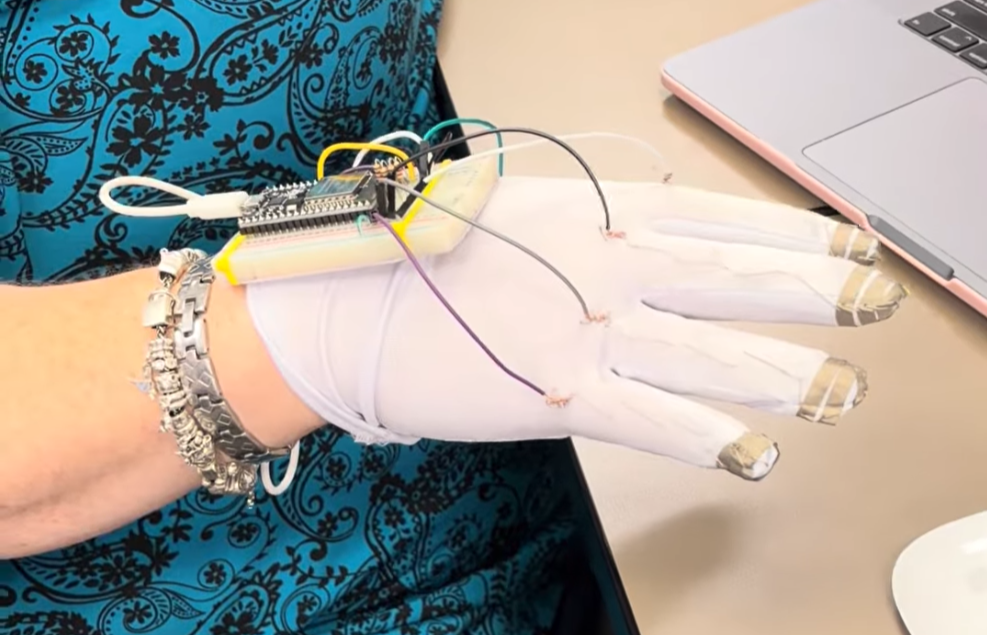
BLE Gesture Glove
ESP32
BLE
Python
Conductive fabric/contact pads
C++
The BLE Gesture Glove is a wearable human-computer interaction device designed to transform simple hand gestures into wireless digital commands using Bluetooth Low Energy (BLE). The project combines embedded systems engineering, wearable electronics, Bluetooth communication, and custom software integration into a compact and intuitive control interface.
The glove was constructed using conductive contact pads sewn directly into the fabric of each finger. The thumb acts as a common contact point, and when the user touches the thumb to one or more fingers, electrical connections are formed. These contact combinations are detected by an ESP32 microcontroller embedded within the glove.
Each gesture combination corresponds to a unique command or action. Once a gesture is recognized, the ESP32 processes the input and transmits a BLE notification to a connected host computer. A custom Python-based BLE client running on the host subscribes to these notifications and translates them into executable commands, keyboard shortcuts, automation events, or application controls.
The communication architecture is built around the BLE GATT (Generic Attribute Profile) model. The ESP32 operates as a BLE peripheral/server and exposes custom GATT characteristics that allow the host system to receive gesture-triggered command events in real time. BLE notifications were used to minimize latency and reduce power consumption while maintaining responsive interaction.
The project explores the intersection of wearable technology and intuitive human-machine interfaces. The glove effectively functions as a customizable wireless command controller capable of triggering actions without requiring traditional input devices such as keyboards, mice, or touchscreens.
Potential applications include:
Accessibility and assistive technology
Presentation and media control
Robotics and remote systems control
VR/AR interaction systems
Smart home automation
Gesture-based user interfaces
Gaming and simulation environments
The software stack was designed with modularity in mind, allowing additional gestures, commands, and host-side behaviors to be added easily. The host-side Python application can be adapted to trigger virtually any local or networked action, including launching applications, executing scripts, controlling hardware, or interfacing with APIs.
The project also required solving several engineering challenges including:
Reliable conductive contact sensing
Debouncing and false-trigger prevention
BLE device discovery and connection management
Low-latency wireless event transmission
Wearable wiring integration and durability
Real-time command parsing on the host computer
By combining wearable electronics with wireless embedded systems and desktop software integration, the BLE Gesture Glove demonstrates a complete end-to-end embedded interaction platform that bridges physical gestures with digital control systems.
Development Tools:
-VS Code
-Arduino IDE
-Serial debugging tools
-Python virtual environments (venv)
-Git / version control
Key Features:
-Wearable gesture-based control system
-Wireless BLE communication
-Real-time command execution
-Customizable gesture mappings
-Low-power embedded design
-Modular software architecture
-Cross-platform host compatibility
-Expandable command protocol
Skills Demonstrated:
-Embedded systems engineering
-BLE protocol implementation
-Wearable electronics design
-Real-time event processing
-Python systems programming
-Human-computer interaction (HCI)
-Hardware/software integration
-Communication protocol design
-Rapid prototyping and debugging