← All Projects
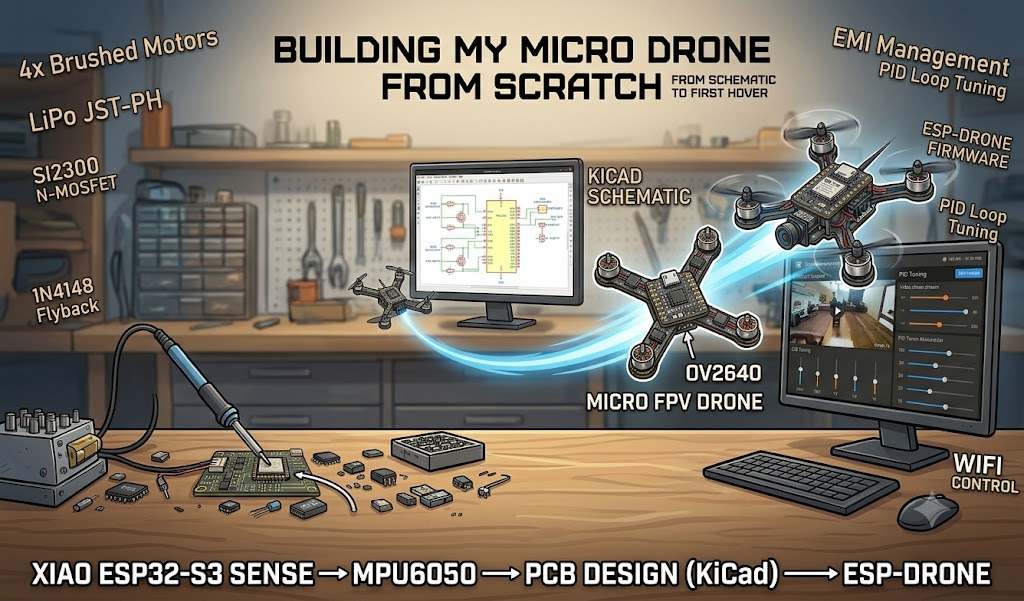
Custom Micro FPV Drone
June 2026
XIAO ESP32-S3 Sense
ESP-Drone
KiCad
MPU6050
In progress
Inspired by the ESP-FLY YouTube build, this project set out to understand every layer of a flying system — from schematic to soldered joint to first hover. Rather than ordering pre-made Gerber files, I opted to design an original PCB in KiCad, treating the board itself as the structural frame of the drone in a cross/X configuration.
The main controller is a Seeed XIAO ESP32-S3 Sense, chosen for its compact footprint, integrated OV2640 camera via a board-to-board connector (no ribbon wiring required), and the ability to run Espressif's open-source ESP-Drone firmware over WiFi. Each of the four brushed motors is driven by an SI2300 N-channel MOSFET with a 1N4148 flyback diode and 10KΩ pull-down resistor — designed as a reusable hierarchical sheet in KiCad and instanced four times.
Attitude sensing is handled by an MPU6050 IMU (bare QFN-24 IC) placed at the exact center of the board for balanced sensor readings, communicating with the ESP32-S3 via I2C. Power is delivered through a JST-PH 2.0mm LiPo connector. The schematic is structured into five functional blocks: XIAO header, per-motor driver (hierarchical), MPU6050 circuit, power section, and status LEDs — with a solid ground pour on the back copper layer for EMI management.
Build plan
1 Hardware selection & research
Evaluated ESP32-CAM vs XIAO ESP32-S3 Sense; settled on Sense for pin count, camera integration, and weight. Mapped GPIO assignments for motors, I2C, and IMU interrupt.
2 Schematic design in KiCad
Build five schematic blocks: XIAO header, motor driver hierarchical sheet (×4), MPU6050 bare IC circuit, power section, status LEDs. Source XIAO footprint from SnapEDA.
3 PCB layout
Design X-shaped board (~100×100mm tip-to-tip). Place MPU6050 dead center, XIAO above/below it, MOSFETs near motor pads. Add solid ground pour on back copper layer. Motor pads at arm tips.
4 Fabrication & assembly
Export Gerbers; order from JLCPCB (5 boards ~$2 + shipping). Solder SMD components — SI2300, 1N4148, 0805 passives, JST-PH. Reflow or hot-air for MPU6050 QFN-24 (or use GY-521 breakout to avoid reflow).
5 Firmware & flight testing
Flash ESP-Drone firmware, configure motor GPIO mapping, tune PID loop. Initial flight without camera; attach OV2640 Sense board once stable flight is achieved.